
Key Takeaways
- Biodegradable and compostable packaging serve different environmental purposes and should be understood distinctly by buyers.
- Understanding disposal conditions is crucial when choosing between compostable and biodegradable products manufacturers in Ahmedabad.
- Breakdown times of biodegradable and compostable materials vary significantly based on composition and environment.
- Compostable packaging produces organic matter, while biodegradable packaging focuses on biological degradation over time.
- Clear terminology is essential; verify packaging claims and disposal pathways to avoid confusion.
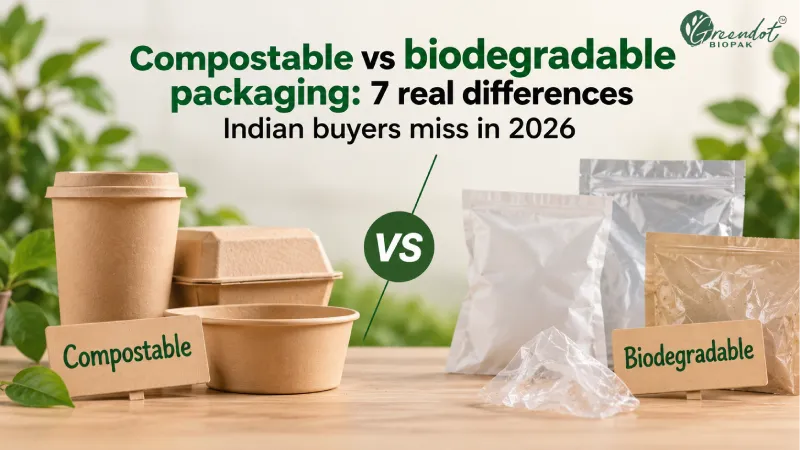
Choosing sustainable packaging is no longer simply about finding an alternative to conventional materials. Compostable and biodegradable packaging can look similar, but they are not the same, and this difference matters when businesses select materials for products, food service, retail, or other applications. For buyers working with compostable and biodegradable products manufacturers in Ahmedabad, understanding these seven differences can help avoid confusion and make a more suitable packaging decision.
Biodegradable and compostable are not synonymous.
The two terms are often used together, but they describe different environmental outcomes.
Materials that are biodegradable are made to decompose naturally through biological processes. Compostable materials are also designed to break down naturally, but the important distinction is that they are intended to break down into compostable matter under suitable composting conditions.
The main difference is not simply whether a material breaks down, but what happens during that process and under which conditions.
1. The End Result Is Different
The first difference buyers should understand is the result after disposal.
Biodegradable packaging may break down through biological activity over time, depending on its material composition and surrounding conditions. Under the right circumstances, compostable packaging is made to decompose into materials that can be composted.
That makes the end-of-life objective different. When evaluating packaging, we should look beyond the label and understand the intended disposal route.
2. Disposal Conditions Can Differ
Disposal is one of the most commonly overlooked points.
In an appropriate natural setting, a biodegradable product may break down, but the rate and extent of the breakdown may vary depending on the material itself, moisture, temperature, oxygen, and microbial activity.
Compostable packaging is generally associated with composting conditions. This means buyers need to consider whether an appropriate composting pathway is available for the intended application.
For businesses comparing suppliers, packaging selection should match the disposal infrastructure available to the end user.
3. Breakdown Time Is Not Automatically the Same
It is a mistake to assume that every biodegradable product breaks down quickly, or that every compostable product follows exactly the same timeline.
Material composition and environmental conditions have a major role in how degradation takes place. This means the words “biodegradable” and “compostable” alone do not tell the complete story.
Indian buyers should therefore ask suppliers for material-specific information instead of making assumptions based only on marketing terminology.
4. Compostability Has a More Specific Meaning
Because it generally refers to a material’s capacity to decompose through biological processes, “biodegradable” is a more comprehensive phrase.
“Compostable” is more specific because the material is intended for composting and a defined end result. For buyers, this distinction matters when sustainability goals are linked to organic waste processing or composting systems.
When speaking with compostable and biodegradable products manufacturers in Ahmedabad, it is useful to ask exactly how the product is intended to be disposed of after use.
5. The Right Choice Depends on the Application
There is no single sustainable packaging material that is automatically suitable for every business.
A buyer needs to consider what the packaging is carrying, how it will be handled, where it will be disposed of, and what type of end-of-life pathway is realistically available.
For example, packaging used in food service may have different requirements from packaging used in retail, shipping, or other commercial applications.
The better approach is to select material based on the complete use cycle rather than choosing a product only because it carries an “eco-friendly” label.
6. Labels Can Create Buyer Confusion
Packaging terminology can sometimes make product comparison difficult.
Here are some points buyers should check before making a decision:
- ✔ Read the exact material description provided by the manufacturer.
- ✔ Ask whether the product is compostable, biodegradable, or both.
- ✔ Check the intended disposal environment.
- ✔ Ask about the conditions required for breakdown.
- ✔ Confirm whether the supplier provides relevant product documentation.
- ✔ Match the material with the actual application and disposal process.
A clear product description is more useful than relying on a general sustainability claim.
7. Supplier Knowledge Matters as Much as the Material
The final difference is often overlooked: the quality of information available from the supplier.
A buyer may understand the difference between compostable and biodegradable packaging in theory, but still select the wrong solution if the supplier does not clearly explain material characteristics, intended use, and disposal requirements.
This is why choosing an experienced packaging partner is important. Good supplier guidance helps buyers compare materials according to practical requirements rather than vague environmental terminology.
Compostable vs Biodegradable Packaging: At a Glance
| Comparison Point | Compostable Packaging | Biodegradable Packaging |
|---|---|---|
| Basic meaning | Designed to break down under composting conditions | Designed to break down through biological processes |
| Main focus | Composting and resulting organic matter | Biological degradation |
| Disposal pathway | Linked to suitable composting conditions | Depends on material and environment |
| Buyer consideration | Availability of suitable composting route | Material-specific degradation conditions |
| Terminology | More specific | Broader |
What Indian Buyers Should Check Before Ordering
Purchasing decisions based on logical questioning prior to choosing a packaging product are the most accurate.
One should never take it for granted that two products which share similar environmental claims will show identical behavior after being disposed. It is necessary to consider material details, applications, disposal circumstances, and supplier documents.
The company that places orders with Ahmedabad’s producers of biodegradable and compostable goods would find this strategy helpful.
Why Choose Us
Greendot Biopak is involved in developing sustainable packaging solutions that take into account all product considerations. We realize that when buying from B2B channels, the buyer requires more than just a general environmental consideration; he or she wants to be informed about the kind of material that is being considered. Our entire approach is based on assisting our customers in making informed product decisions for their applications and material end-of-life uses.
Conclusion
The concepts of compostable packaging and biodegradable packaging are quite similar in many ways; however, they are not entirely synonymous. The major distinctions between the two involve their final results, disposal requirements, degradability process, naming conventions, and use cases. For companies in India, being aware of such distinctions could help purchase appropriate packaging materials. One could learn more about sustainable packaging by asking relevant questions to the compostable and biodegradable products manufacturers in Ahmedabad.
Ready to discuss the right sustainable packaging solution for your business? Greendot Biopak is here to help you evaluate suitable options for your requirements.
Call us: +91 951-239-9155
Email: info@greendotbiopak.com